
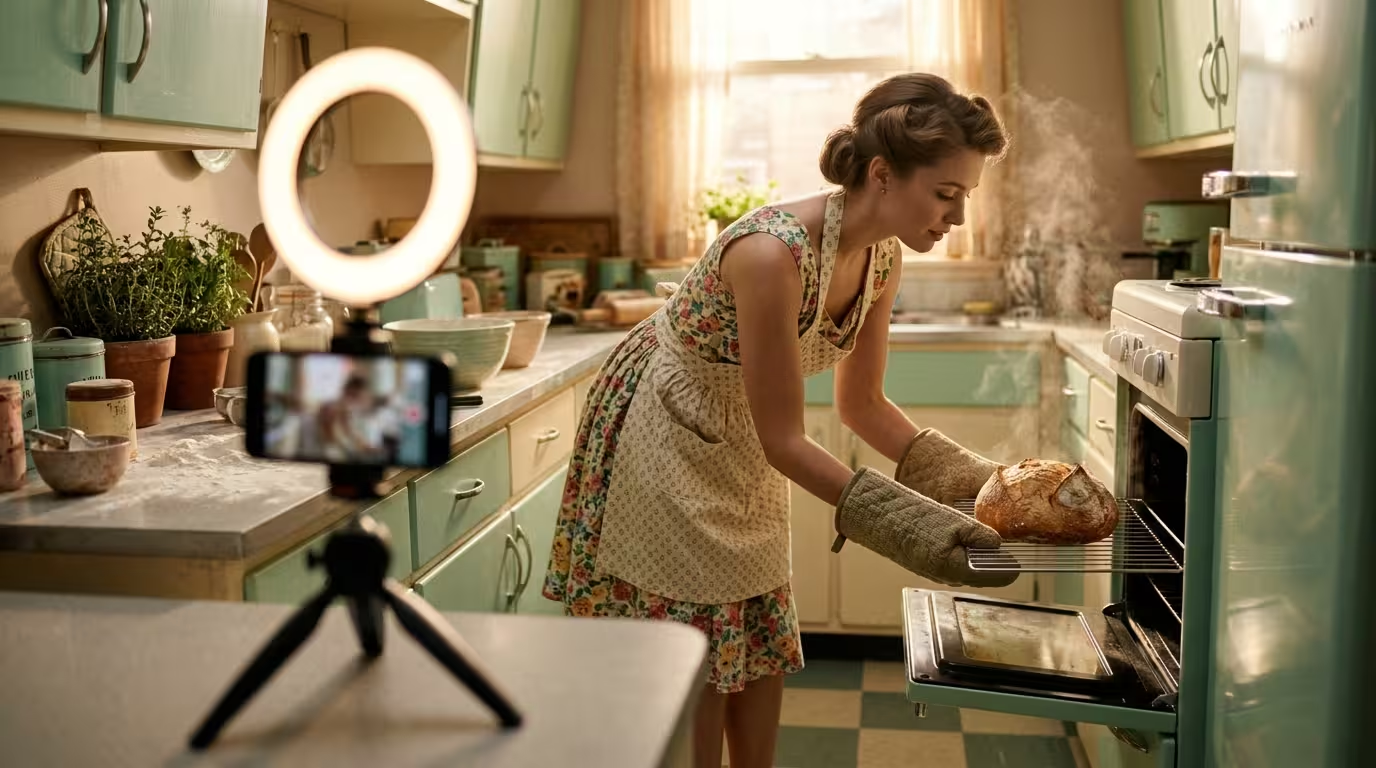
What does tradwife mean, and why is your feed suddenly full of them? A woman in a flower-print dress pulls sourdough from the oven and ices a cake without checking the recipe. She signs off with a smile from another decade. The counter reads two million views, and the algorithm gives her a name: tradwife, short for traditional wife. The phenomenon has flooded social media for a couple of years now. It drags behind it a question almost nobody answers well: what does any of this have to do with sugar dating? The short answer: the two worlds resemble each other more than their critics admit, and less than anyone who confuses them believes. The full answer is this article.
The aesthetic
Aprons, 1950s recipe books, spotless kitchens, golden light. The layer you see in thirty seconds of video.
The project
Home and family as a full-time calling, by choice. The real layer, the one that doesn’t fit in a video.
The debate
Chosen freedom, or dependence with a pretty filter? The layer that neither the algorithm nor the comment section has settled.
What is a tradwife?
A tradwife is a woman who chooses the lifestyle of a traditional wife: the home at the center, the kitchen as a language, family as the project. Often, faith in the background. The visual reference is the housewife of the 1950s and 60s (vintage dresses, red lips, Sunday baking), updated with sourdough starters, vegetable gardens and, in the full version, homeschooling. Call it the fifties with wifi. The phenomenon itself, though, is a child of this decade. It was born on Instagram and TikTok, and it has famous names. Hannah Neeleman, known as Ballerina Farm, raises her eight children on a Utah farm in front of millions of followers. One magazine profile of her life turned into a worldwide argument about what the lifestyle shows and what it hides, as NBC’s Today recounted. The British writer Alena Kate Pettitt turned it into a school with The Darling Academy and her etiquette books. And in Spain the public has crowned Roro, who cooks impossible recipes “for Pablo” in a whipped-cream voice. Although she, and the detail matters, has never claimed the label. That nuance protects all of them: tradwife is an identity you choose, not a diagnosis the algorithm pins on you for wearing an apron.
Where the tradwife movement comes from — and why now
The movement has a birth certificate: Fascinating Womanhood, the manual Helen Andelin published in 1963 defending classic femininity as the road to a happy marriage. Sixty years later, the granddaughters of those readers have resurrected it one hashtag at a time. Videos tagged #tradwife add up to hundreds of millions of views, and the phenomenon now gets explainers everywhere, universities included. The press runs profiles, the talk shows run debates, and the comment sections run wars. Why now? Because modern life is exhausting, and against the double shift of office and home, a quiet kitchen with fresh bread sells itself as a fantasy of simplicity. There’s an unromantic engine underneath too: for the big creators, the apron is a job. A team behind the camera, sponsors in the description, a book on the way. That’s the first clue that the fantasy and the reality live at different addresses. One inconvenient fact for anyone dismissing it as grandmother nostalgia: most of its creators are in their twenties. Generation Z is, as usual, on every corner of the board at once.
What tradwife and sugar dating actually share
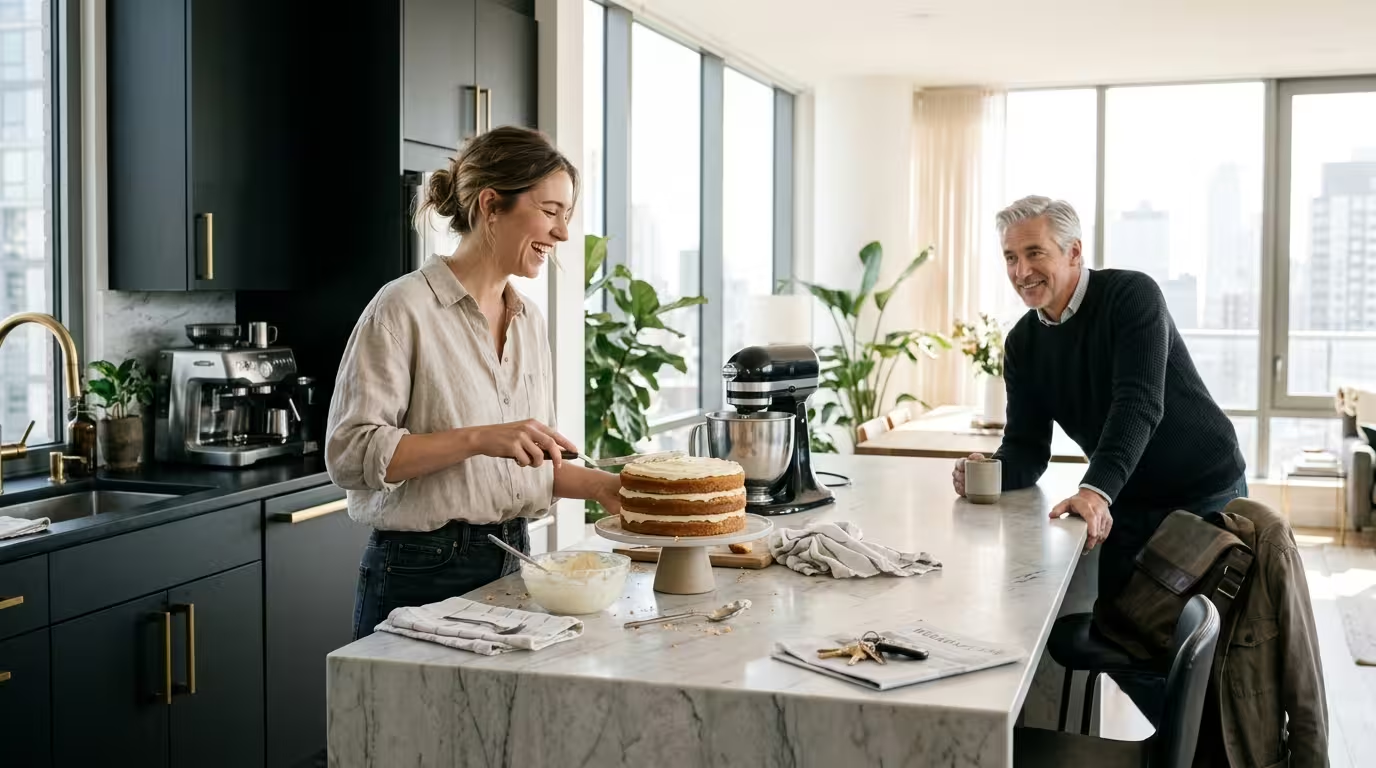
More than either camp would admit out loud. First: the roles get said, not assumed. In both worlds he tends to be the one who provides and she the one who tends the shared life. And they settle it face to face. Most couples decide that without ever deciding it, arguing about who loaded the dishwasher last. Second: both reject the single script. The dominant culture says fifty-fifty or nothing; the tradwife and the sugar baby answer that their balance is theirs to choose. Third: clarity as a virtue. Knowing what you offer and what you hope for from day one is the foundation of both lifestyles. In sugar dating it’s simply the house rule. And fourth: both collect sermons from strangers who know how to live other women’s lives better than anyone. The tradwife gets told she betrayed her generation; the sugar baby, that her relationship can’t be real. Both have learned the same answer: a life that needs defending in front of strangers still beats one that needs their permission.
A sugar baby in Munich summed it up with her Saturday sponge cake: “I bake for him because I feel like it, and that’s why it comes out well. The day it becomes a duty, it’ll come out like a motorway hotel’s.” That sentence holds the whole border between choosing a gesture and owing one.
Tradwife vs sugar baby: what they don’t share
| Tradwife | Sugar baby | |
|---|---|---|
| The project | Marriage and family, full time | Dating and company, with her own life intact |
| The horizon | Decades, children, a surname | Whatever the two of them want, no shared house by default |
| The home | Her craft and her territory | Nobody irons anybody’s shirts |
| Iseseisvus | The classic version hands it to the joint project | Kept on principle, not out of distrust |
| The stage | Her own kitchen, in public | Real life, with discretion |
The deep difference sits in the fourth row. The classic tradwife bets her autonomy on the joint project: if the project goes well, her life goes well. The sugar baby plays it the other way around. Her independence is her parachute, and that’s exactly why she can afford to choose every gesture. They are two different answers to the same question of how to share out a relationship. Neighbours, not twins.
Can a sugar baby end up a tradwife?
She can, and some do. But by the only road that actually exists: the relationship grows and becomes a full couple. Marriage arrives, more often than people think, and inside that marriage she chooses what kind of wife she wants to be. Some choose the vintage apron and thrive. What doesn’t exist is the third-date tradwife: a part performed for a few weeks isn’t a lifestyle, it’s a play, and plays exhaust the actress and disappoint the audience. If the profile sounds familiar (classic values, quiet plans, zero exhibition), that woman already has a full portrait in the conservative sugar baby, her first cousin in this world.
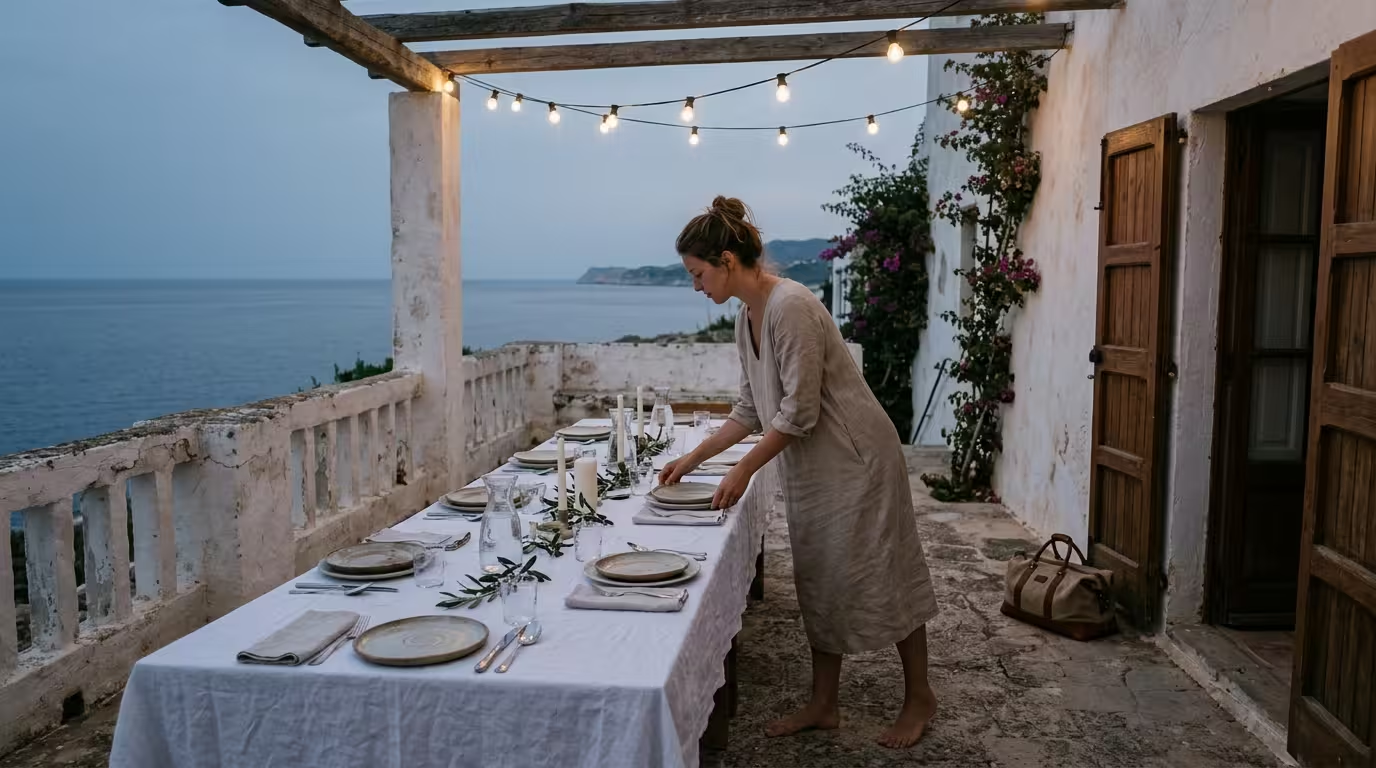
A sugar baby in Seville tried the part for a whole summer at his house on the coast: “I played house for three months. Market in the morning, long-tablecloth dinners at night. I learned two things: I love cooking for someone, and on Monday I need my studio.” Both lessons are worth gold, and only slow trials teach them. That’s the honest way to try the lifestyle on: a season as a guest, not a vow, with her own key in her pocket the whole time.
And for him: what the tradwife wave means for a sugar daddy
Plenty of men watch those videos and feel an old dream wake up: a warm house, bread in the oven, somebody glad you walked in. Fair enough. Two notes before you bring that dream to your dates. One: dating isn’t marriage. A sugar relationship lives in dates, in travel, in conversation, not in a shared kitchen. So don’t expect the third date to feel domestic. Expecting it is a close cousin of the classic mistakes sugar daddies make, and it scares away exactly the women you want. Two: the woman who shares those values without the costume does exist here. Quiet plans, classic manners, zero exhibition, and she responds to patience, not to a list of duties. Court her as what she is: a free woman with a life of her own. Do that, and one day you may get the warm house too. Ask for the apron on arrival and you’ll get a performance, briefly, followed by an empty chair.

The fine print the algorithm won’t show you
The debate around tradwives isn’t an invention of their critics; it lives inside the movement itself. Depending on another person for everything is a strong bet. Life takes sharp turns, and whoever hands over every key is left without a door of her own if the turn comes. Nobody films that Tuesday. The most sensible voices in the phenomenon say it openly: choose the apron if it makes you happy, but keep something of yours. A degree that doesn’t expire. A skill. A floor of your own. On that point, curiously, the smart tradwife and the smart sugar baby align to the millimetre, because the freedom to choose a role is proven by being able to walk out of it.
The tradwife and the sugar baby resemble each other in the only thing that matters: both chose their role out loud, without asking anyone’s script for permission. If choosing is your thing, loo oma profiil ja leia oma sugar daddy või sugar baby.
Two neighbouring worlds, one lesson
The tradwife phenomenon proves something sugar dating has known for years: relationships work when the roles are chosen and spoken, not inherited and assumed. You can want a 1950s kitchen, a dating life with no shirts to iron, or both at different stages of your life. The only version that fails is the one other people put on you. And if your way of choosing starts with meeting someone who also knows what he’s looking for, create your profile and start choosing on our network. This decade is oversupplied with inherited scripts.
Tradwife and sugar dating: FAQ
What does tradwife mean?
Tradwife is short for traditional wife: a woman who chooses the lifestyle of a classic housewife, with the home, the kitchen and family at the center, often with faith in the background, and an aesthetic inspired by the 1950s. The term grew up on Instagram and TikTok, where tradwife videos add up to hundreds of millions of views.
What is the difference between a tradwife and a sugar baby?
The project. A tradwife builds a marriage and a home as a full-time calling; a sugar baby lives dates and company while keeping her own life intact. They share the essential part, roles chosen and said out loud, and differ in everything domestic: in sugar dating, nobody irons anybody’s shirts.
Can a sugar baby become a tradwife?
Yes, by the real road: the relationship grows, marriage arrives, and inside it she chooses to be a traditional wife. It happens more often than people think. What doesn’t work is performing the part on the third date; a role played for a few weeks isn’t a lifestyle, it’s a play.
Is sugar dating a version of the tradwife phenomenon?
No. They’re neighbours, not twins: both choose classic roles out loud, but one is a marriage project and the other is a way of dating. Confusing them is confusing a house with a journey, and each one deserves to be judged by its own rules.
Why is the tradwife movement so popular now?
Nostalgia for simplicity in an exhausting decade, plus an algorithm that rewards vintage aesthetics. One nuance gets missed: most tradwife creators are in their twenties, so this is a young rereading of an old model rather than a literal return to it.
Does being a tradwife mean giving up feminism?
Depends who you ask. For some it’s the freedom to choose a classic role; for others, dependence with a pretty filter. The point where almost everyone lands: chosen freely, with a floor of her own kept safe, it’s a personal choice that deserves respect.
How do I know if that lifestyle is for me?
By trying it slowly and in small doses: a season, not a promise. And by measuring one thing only, whether the role gives you energy or takes it from you at the end of the day. A part that drains you isn’t an identity. It’s a performance.